Shopping Cart

When a Summeller describes a wine as "with cherry notes, leather and a mineral ending," nobody is surprised. But when someone applies the same vocabulary to chocolate — "fruity, with raspberry acidity and a floral aftertaste" — many still doubt. The Chocolate Bean to Bar is a gastronomic product, we will not tire of saying it, and as such has its own way of interpreting.
Chocolate tachkers Bean to Bar (I do not like to say chocolate sommelier) We develop a language of its own that deserves to be explained.
¿Exaggeration? Gastronomic snoobism? At all. It is applied chemistry, and understanding it completely transforms the way of consuming fine chocolate.
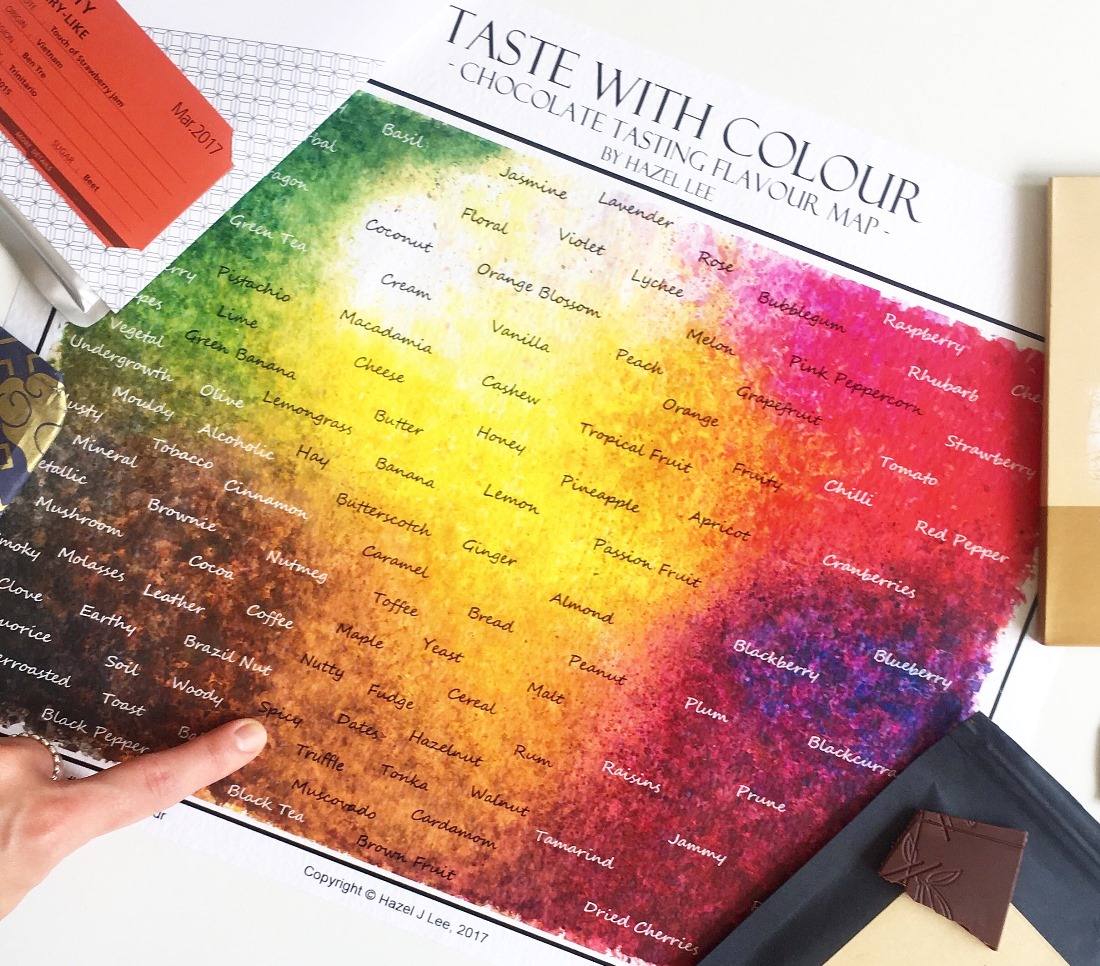
We will explore the aromatic profile of cocoa from a technical perspective: what compounds each family of flavors generate, how the geographical origin and the fermentation process condition them, and how tools as the map Taste with Color —development by the food scientist Hazel Lee— they help us systematize a sensory experience that it is otherwise difficult to articulate.
Cocoa as a complex aromatic system
Cocoa is one of the food with the highest known aromatic complexity. More than 600 volatile compounds have been identified in chocolate, compared to approximately 200 of wine or 150 coffee.
This wealth is not accidental: it is the result of a chain of biochemical transformations that begins in the fruit pulp and concludes, weeks later, in the shell of the worker.
The process of fermentation it is the most determining point of starting. During 5 to 7 days, fermentation in wooden drawers, yeast and lactic and achetic bacteria transform the sugars of pulp into ethanol, lactic acid and acetic acid.
This acid and hot environment penetrates inside the grain and triggers a cascade of enzymatic reactions that degrade proteins in free amino acids and polysaccharides in simple sugars. These precursors are the raw material of the flavors that we will detect months later on the tablet.
The roasting add a second layer of complexity by reactions of Maillard—the same family of reactions that gives color and aroma to toasted bread or to the grilled meat— and the caramelization of sugars.
The temperature, the duration and the profile of Test (soft, medium, dark) determine which aromatic families predominate in the final result: a soft toast preserves the floral and fruit notes better; A deeper toast develops notes of dried fruits, coffee and intense black chocolate.
The aromatic families of cocoa
Chocolate to taste or taste chocolate is to recognize the aromas and flavors of the product.
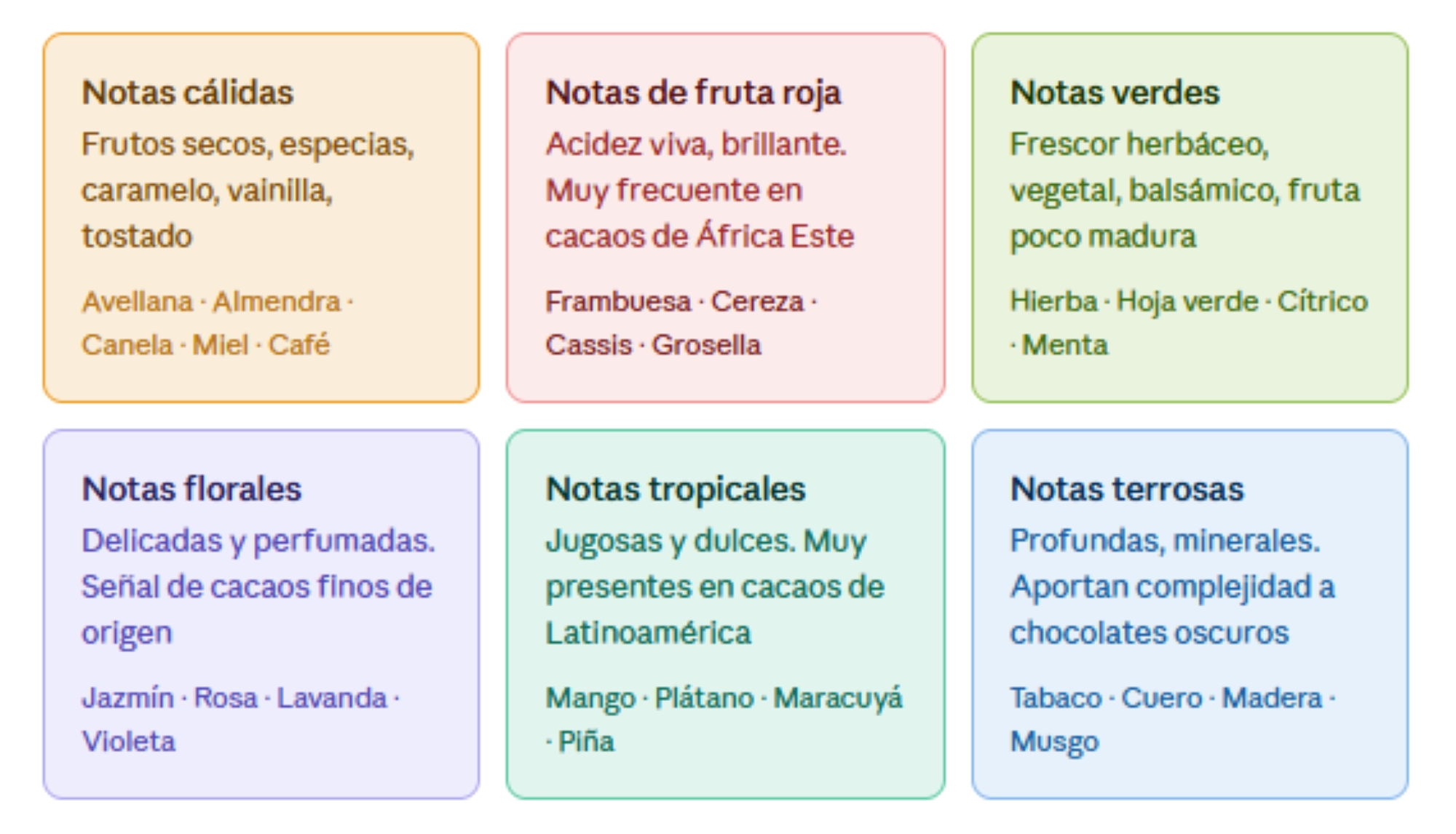
The sensory profile of cocoa can be organized in families, each linked to specific groups of volatile compounds and conditions of origin or process determined.
Hot notes: dried fruits, spices and caramel.
They are the most recognizable notes and those that the average consumer intuitively associates with chocolate. They come mainly from the reactions of Maillard during the roast, which generate pyrazines, furans and aldehydes.
Pyrazines are especially characteristic: they are the compounds responsible for the aroma to roasted fruits, coffee and chocolate in a classic sense. Within this family we find hazelnut, almond, cinnamon, honey and coffee.
Chocolates with a cocoa percentage between 65% and 75%, correctly roasted, usually exhibit this profile very clearly.
Venezuela's cocoa are a good example of this family of flavors.
Red fruit notes: live and bright acidity
This family is perhaps the most surprising for those who are closer to the chocolate of origin for the first time. Raspberry, cherry, Cassis and gooseberry are perfectly valid descriptors for certain cocoons, and their origin is strictly biochemical.
The organic acids —acetic, lactic, citrus— generated during fermentation create the base acid profile. But they are esters and aromatic alcohols that provide the specific fruit characteristic. Diacetile and acetaldehyde, present in well fermented cocoas, produce notes that the brain classifies as "red fruit."
This family is especially frequent in East Africa cocoas: Madagascar, Tanzania and India are regular sources of chocolates with brilliant acidity and marked red fruits notes. Rapid fermentation favored by the temperatures of these regions, combined with local cocoa varieties, produces this characteristic aromatic line.
Green notes: fresh herbaceous, vegetable, balsamic and little ripe fruit
The green notes are frequently misinterpreted as a defect, but in the right measure they are a legitimate part of the profile of many fine cocoos.
Its presence is due to compounds such as hexanal and other short-chain aldehydes, as well as specific pyrazines that evoke fresh grass, green or citrus leaf.
An excess of these notes, however, can indicate an insufficient fermentation: aromatic precursors have not been transformed correctly, and persist compounds that in small quantities are interesting but in large proportions are astringent or unpleasant.
In balanced doses, the green notes —erbaceous, balsamic, of little mature fruit — bring freshness and complexity to chocolates that would otherwise result in plans or excessively sweet.
The cocoa of the Ucayali region in Peru is a good example.
Floral notes: delicacy and Fineness of Origin Jasmine, Rose, Lavender, Violet: When they appear in a chocolate, they are unequivocal signal of a high quality cocoa, with good genetics and careful process.
The responsible compounds are mainly terpenes such as linalool and geraniol, as well as low perception threshold floral esters. These molecules are extremely volatile and sensitive to heat, so an excessive roast destroyes them completely.
Chocolates with pronounced floral notes are usually elaborated with soft toast profiles and controlled shell times.
The Ecuadorian national cocoa, with its famous "up" aroma, is the most cited example: a combination of floral notes and Frutps SECPs that makes it one of the most appreciated cocoas in the world.
Tropical notes: juzity and sweetness of Latin America mango, banana, maracuyá, pineapple; This family is a characteristic of many Latin American cocoons, especially those cultivated in Nicaragua, El Salvador, Haiti and the Amazonian regions of Peru and Bolivia.
The esters of isoamyl — the same compound that gives the aroma characteristic to the ripe banana — and the butyrate esters are the main responsible.
The combination of genetic biodiversity of cocoa (greater presence of national and trinitarian varieties), volcanic soils rich in minerals and slow and wet fermentations favors the development of this aromatic profile.
Haiti cocoa is a good example of this tropical note.
Earthy notes: depth and mineral complexity Tobacco, leather, wood, moss: Earth notes are the most polarizing among uninitiated consumers, but for the expert taster represent a dimension of complexity that elevates fine chocolate to a different category.
They come from compounds such as guaiacol and 4-methylguaiacol, generated during the grain toilet with high content in ligninas, as well as geosmin and other microbial metabolites that cocoa absorbs soil and environment during cultivation and fermentation.
Chocolates of African origin with a high percentage of cocoa (between 70% and 85%) tend to exhibit these notes with greater intensity.
The Sao took and even some fililpines are a good example.
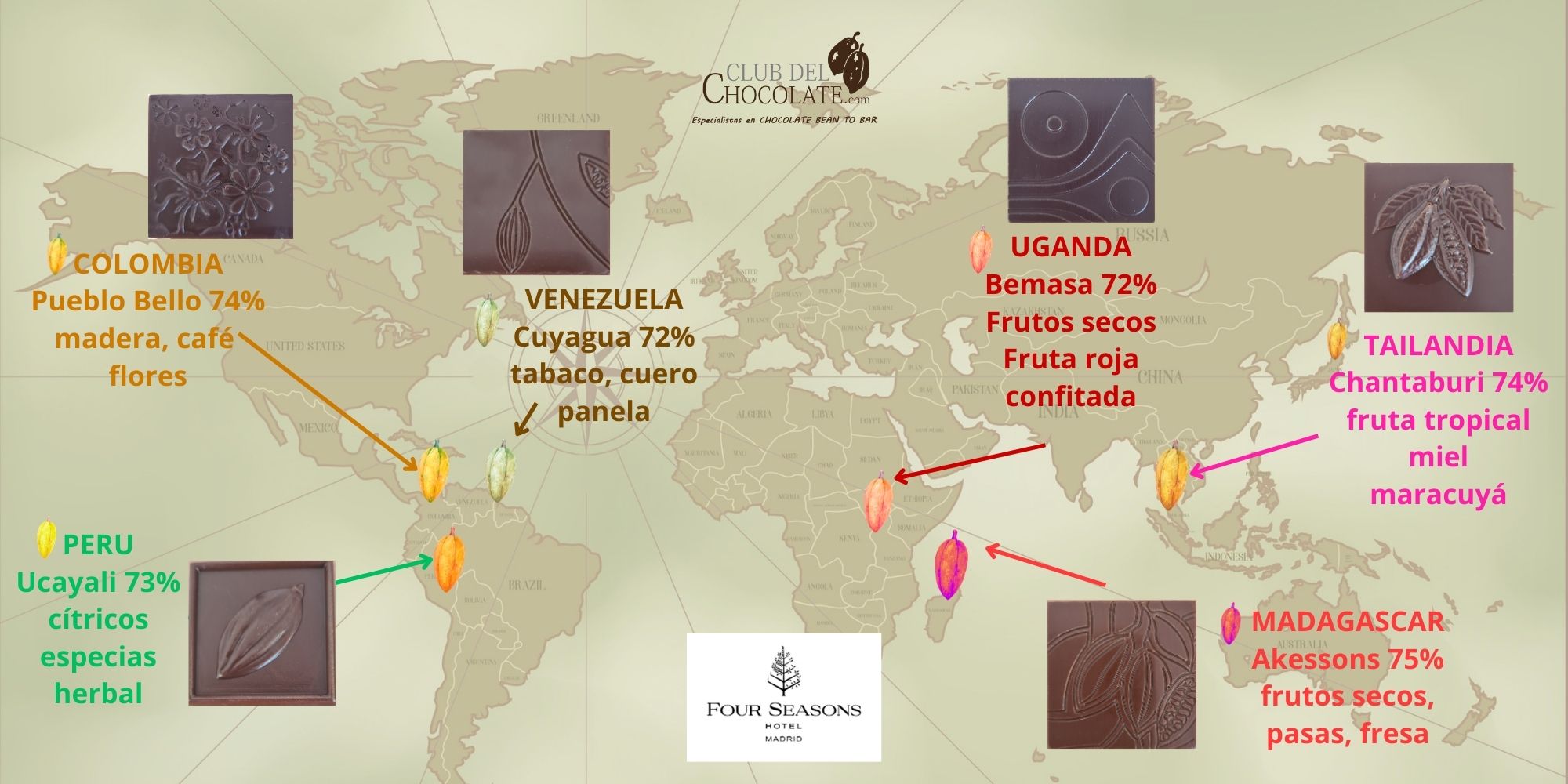
The Role of Geographic Origin
The concept of terroir—so deeply rooted in wine culture—is equally applicable to cacao, albeit with its own nuances. The soil composition, altitude, microclimate, local genetic varieties, and agricultural practices of each region leave a recognizable aromatic imprint on the bean. Broadly speaking, and without claiming to be exhaustive:
• East Africa (Madagascar, Tanzania): notes of red fruit, pronounced acidity, clean and bright profile.
• Latin America (Ecuador, Peru, Venezuela, Colombia): tropical, floral, caramel, great diversity of profiles according to the exact region.
• Central America and Caribbean (Guatemala, Trinidad, Grenada): Complex profiles with frequent presence of spices, tobacco and dried fruits.
• West Africa (Ghana, Cote d'Ivoire): More neutral profile cocoas, with warm and earthy notes. Base of the majority of industrial chocolate.
• Asia: fruity cocoa ranging from vibrant mill in India to the intense tropical in Thailand, going through the earthy in the Philippines by synthesizing.
Tools to systematize tasting:
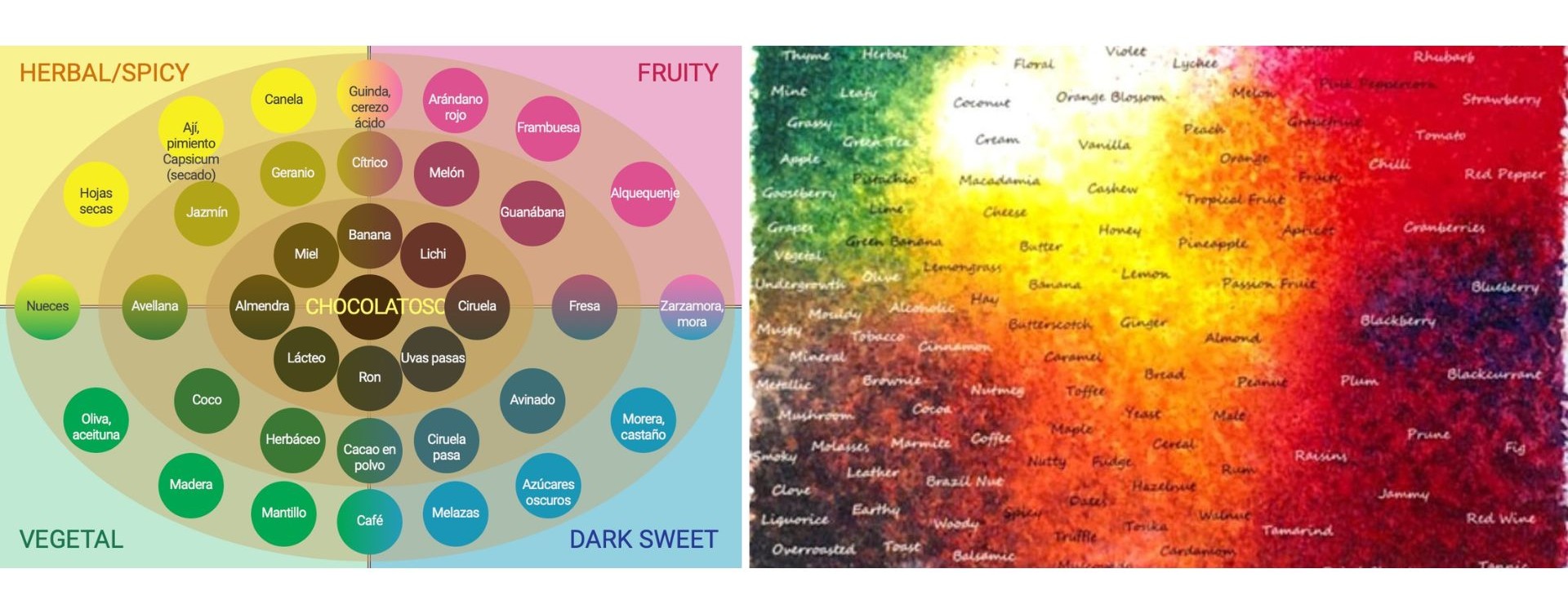
The map Taste with Color qeu have commented is one of the possible tools along with the map of the International Cocoa and Chocolate Tasting Institute. One of the difficulties of sensory learning is the translation of language experience.
The Taste with Color map, developed by Hazel Lee —food Scientist, member of the Academy of Chocolate and Judge of the Academy of Chocolate Awards — proposes an elegant solution: associate families of flavors to colors through the principle of correspondence crossmodal.
This correspondence, documented in cognitive research (Spence, 2012, Parise & Spence), describes the brain's trend to associate attributes of different sensory modalities. In practical terms: When we tattle a chocolate and "we see" mentally a warm amber color, it is more likely that we are perceiving notes of nuts or candy; If mental color is intense red, fruit acidity probably dominates the profile.
The map collects more than 100 flavor descriptors organized by chromatic families, and its main value resides on that it eliminates the technical vocabulary barrier. It is not necessary to know the term "pyrazine" to use the map: just identify a color and explore the associated flavors.
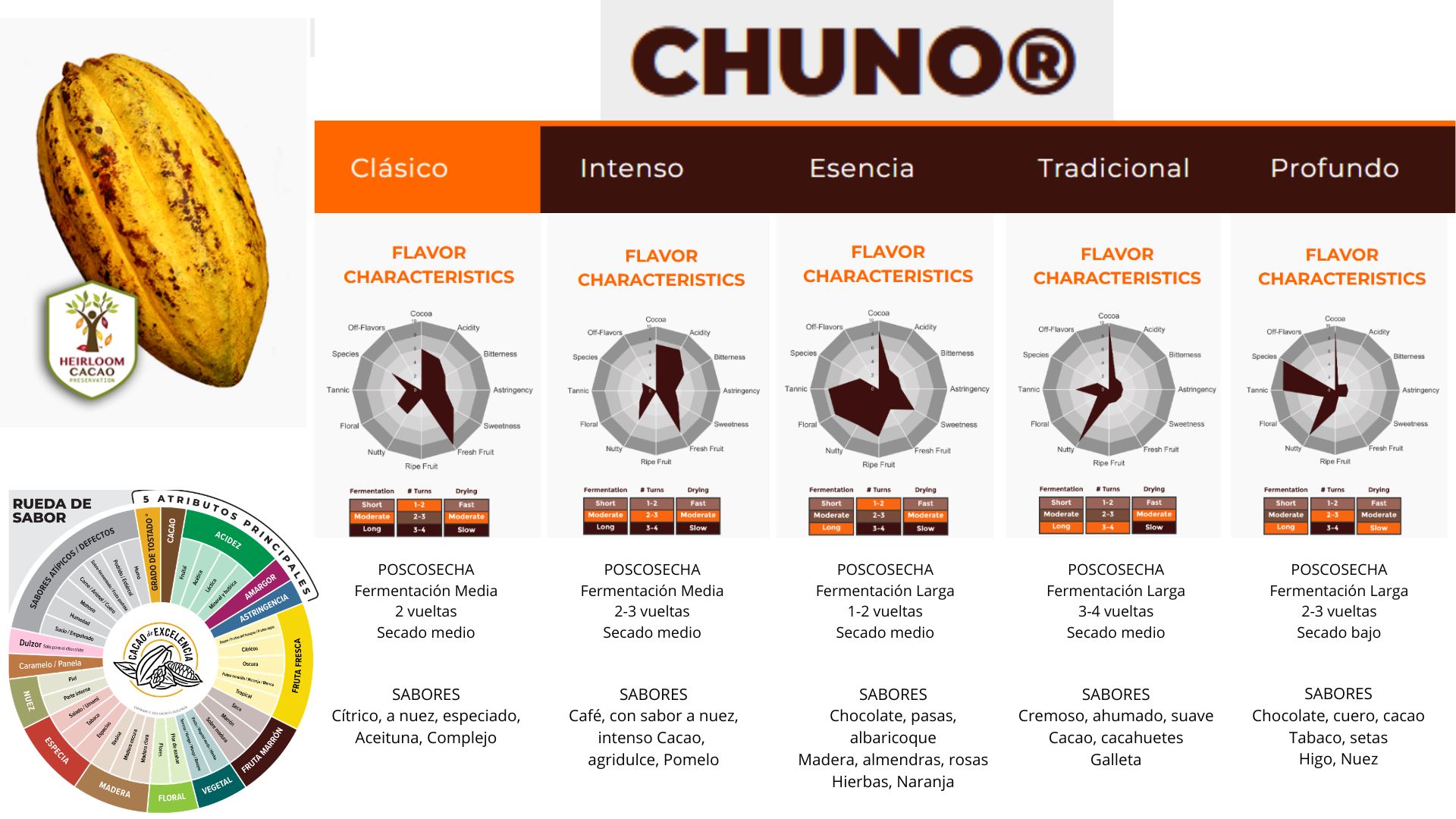
The other map that we usually work is that of the International Cocoa and Chocolate Tasting Institute, prepared by Alex Rast, computer expert and neuroscience applied to chocolate. Its map, prepared working based on neuronal perceptions, joins an application that allows to evaluate with a final score the chocolate.
It is an interactive map that opens fields as you enter each flavor circle. Likewise, it has a "map 2" picking up the possible flavor defects.
In conclusion, learn to describe fine chocolate bean to bar is not an exercise of erudition: it is a way to deepen the experience of gastronomic consumption, to connect with the work of producers, fermenters and chocolatiers, and to make more informed purchase decisions.
The aromatic families described here —forid, red fruit, green, floral, tropical and earthy — are not arbitrary categories: they are based on real chemistry, in concrete molecules that cocoa synthesize through processes Biological and thermal. Understanding them is to understand chocolate from within.
The next time you open a home tablet, before giving the first bite: flee it. Close your eyes. What color do you see?
Do you want to explore each of these families with selected home tablets? Discover our collection in the store
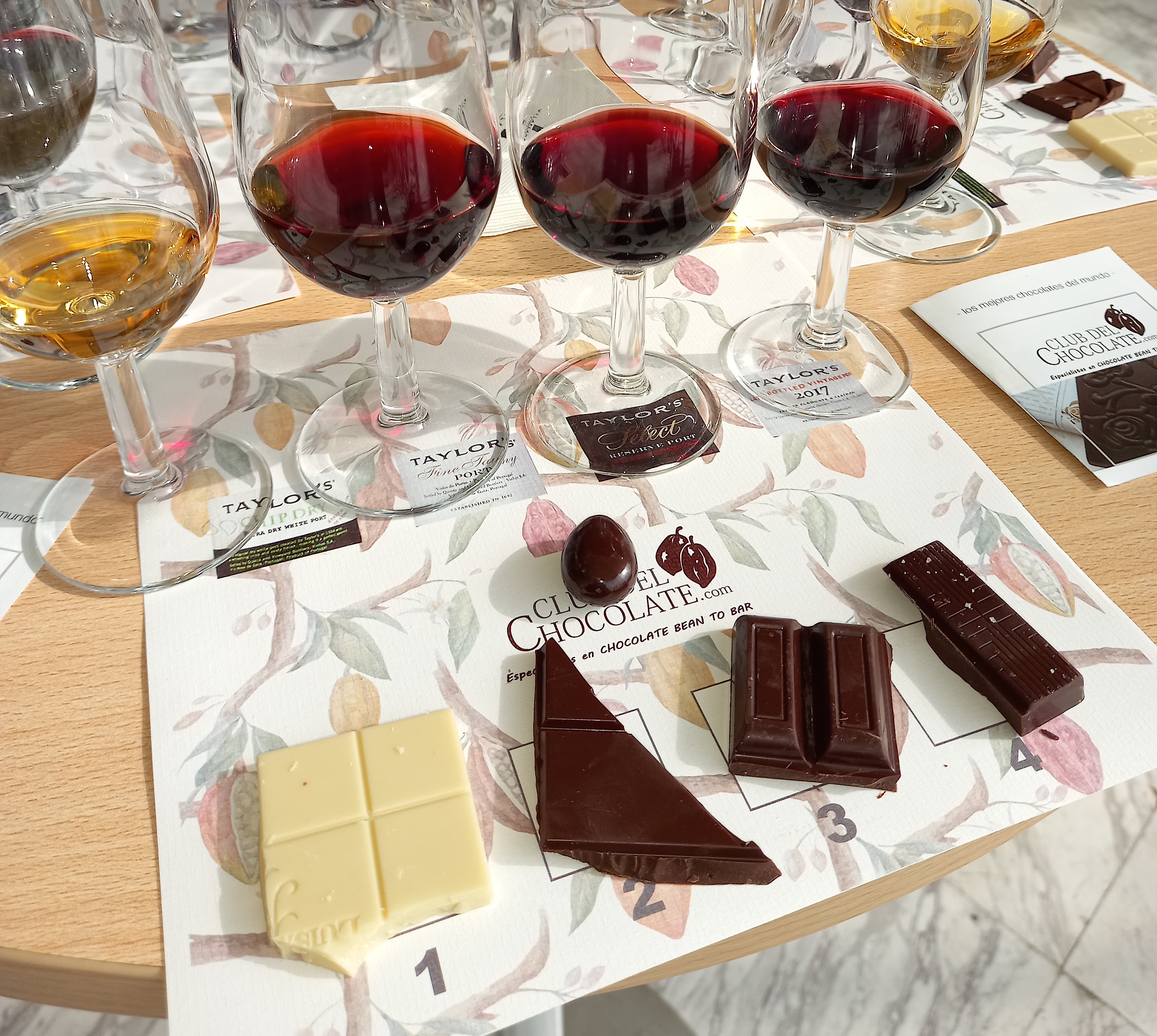
Do you want to deepen the tasting? Our Tasting club it offers you the possibility of tasting a periodic chocolates online session.
When a Summeller describes a wine as "with cherry notes, leather and a mineral ending," nobody is surprised. But when someone applies the same vocabulary to chocolate — "fruity, with raspberry acidity and a floral aftertaste" — many still doubt. The Chocolate Bean to Bar is a gastronomic product, we will not tire of saying it, and as such has its own way of interpreting.
Chocolate tachkers Bean to Bar (I do not like to say chocolate sommelier) We develop a language of its own that deserves to be explained.
¿Exaggeration? Gastronomic snoobism? At all. It is applied chemistry, and understanding it completely transforms the way of consuming fine chocolate.
We will explore the aromatic profile of cocoa from a technical perspective: what compounds each family of flavors generate, how the geographical origin and the fermentation process condition them, and how tools as the map Taste with Color —development by the food scientist Hazel Lee— they help us systematize a sensory experience that it is otherwise difficult to articulate.
Cocoa as a complex aromatic system
Cocoa is one of the food with the highest known aromatic complexity. More than 600 volatile compounds have been identified in chocolate, compared to approximately 200 of wine or 150 coffee.
This wealth is not accidental: it is the result of a chain of biochemical transformations that begins in the fruit pulp and concludes, weeks later, in the shell of the worker.
The process of fermentation it is the most determining point of starting. During 5 to 7 days, fermentation in wooden drawers, yeast and lactic and achetic bacteria transform the sugars of pulp into ethanol, lactic acid and acetic acid.
This acid and hot environment penetrates inside the grain and triggers a cascade of enzymatic reactions that degrade proteins in free amino acids and polysaccharides in simple sugars. These precursors are the raw material of the flavors that we will detect months later on the tablet.
The roasting add a second layer of complexity by reactions of Maillard—the same family of reactions that gives color and aroma to toasted bread or to the grilled meat— and the caramelization of sugars.
The temperature, the duration and the profile of Test (soft, medium, dark) determine which aromatic families predominate in the final result: a soft toast preserves the floral and fruit notes better; A deeper toast develops notes of dried fruits, coffee and intense black chocolate.
The aromatic families of cocoa
Chocolate to taste or taste chocolate is to recognize the aromas and flavors of the product.
The sensory profile of cocoa can be organized in families, each linked to specific groups of volatile compounds and conditions of origin or process determined.
Hot notes: dried fruits, spices and caramel.
They are the most recognizable notes and those that the average consumer intuitively associates with chocolate. They come mainly from the reactions of Maillard during the roast, which generate pyrazines, furans and aldehydes.
Pyrazines are especially characteristic: they are the compounds responsible for the aroma to roasted fruits, coffee and chocolate in a classic sense. Within this family we find hazelnut, almond, cinnamon, honey and coffee.
Chocolates with a cocoa percentage between 65% and 75%, correctly roasted, usually exhibit this profile very clearly.
Venezuela's cocoa are a good example of this family of flavors.
Red fruit notes: live and bright acidity
This family is perhaps the most surprising for those who are closer to the chocolate of origin for the first time. Raspberry, cherry, Cassis and gooseberry are perfectly valid descriptors for certain cocoons, and their origin is strictly biochemical.
The organic acids —acetic, lactic, citrus— generated during fermentation create the base acid profile. But they are esters and aromatic alcohols that provide the specific fruit characteristic. Diacetile and acetaldehyde, present in well fermented cocoas, produce notes that the brain classifies as "red fruit."
This family is especially frequent in East Africa cocoas: Madagascar, Tanzania and India are regular sources of chocolates with brilliant acidity and marked red fruits notes. Rapid fermentation favored by the temperatures of these regions, combined with local cocoa varieties, produces this characteristic aromatic line.
Green notes: fresh herbaceous, vegetable, balsamic and little ripe fruit
The green notes are frequently misinterpreted as a defect, but in the right measure they are a legitimate part of the profile of many fine cocoos.
Its presence is due to compounds such as hexanal and other short-chain aldehydes, as well as specific pyrazines that evoke fresh grass, green or citrus leaf.
An excess of these notes, however, can indicate an insufficient fermentation: aromatic precursors have not been transformed correctly, and persist compounds that in small quantities are interesting but in large proportions are astringent or unpleasant.
In balanced doses, the green notes —erbaceous, balsamic, of little mature fruit — bring freshness and complexity to chocolates that would otherwise result in plans or excessively sweet.
The cocoa of the Ucayali region in Peru is a good example.
Floral notes: delicacy and Fineness of Origin Jasmine, Rose, Lavender, Violet: When they appear in a chocolate, they are unequivocal signal of a high quality cocoa, with good genetics and careful process.
The responsible compounds are mainly terpenes such as linalool and geraniol, as well as low perception threshold floral esters. These molecules are extremely volatile and sensitive to heat, so an excessive roast destroyes them completely.
Chocolates with pronounced floral notes are usually elaborated with soft toast profiles and controlled shell times.
The Ecuadorian national cocoa, with its famous "up" aroma, is the most cited example: a combination of floral notes and Frutps SECPs that makes it one of the most appreciated cocoas in the world.
Tropical notes: juzity and sweetness of Latin America mango, banana, maracuyá, pineapple; This family is a characteristic of many Latin American cocoons, especially those cultivated in Nicaragua, El Salvador, Haiti and the Amazonian regions of Peru and Bolivia.
The esters of isoamyl — the same compound that gives the aroma characteristic to the ripe banana — and the butyrate esters are the main responsible.
The combination of genetic biodiversity of cocoa (greater presence of national and trinitarian varieties), volcanic soils rich in minerals and slow and wet fermentations favors the development of this aromatic profile.
Haiti cocoa is a good example of this tropical note.
Earthy notes: depth and mineral complexity Tobacco, leather, wood, moss: Earth notes are the most polarizing among uninitiated consumers, but for the expert taster represent a dimension of complexity that elevates fine chocolate to a different category.
They come from compounds such as guaiacol and 4-methylguaiacol, generated during the grain toilet with high content in ligninas, as well as geosmin and other microbial metabolites that cocoa absorbs soil and environment during cultivation and fermentation.
Chocolates of African origin with a high percentage of cocoa (between 70% and 85%) tend to exhibit these notes with greater intensity.
The Sao took and even some fililpines are a good example.
The Role of Geographic Origin
The concept of terroir—so deeply rooted in wine culture—is equally applicable to cacao, albeit with its own nuances. The soil composition, altitude, microclimate, local genetic varieties, and agricultural practices of each region leave a recognizable aromatic imprint on the bean. Broadly speaking, and without claiming to be exhaustive:
• East Africa (Madagascar, Tanzania): notes of red fruit, pronounced acidity, clean and bright profile.
• Latin America (Ecuador, Peru, Venezuela, Colombia): tropical, floral, caramel, great diversity of profiles according to the exact region.
• Central America and Caribbean (Guatemala, Trinidad, Grenada): Complex profiles with frequent presence of spices, tobacco and dried fruits.
• West Africa (Ghana, Cote d'Ivoire): More neutral profile cocoas, with warm and earthy notes. Base of the majority of industrial chocolate.
• Asia: fruity cocoa ranging from vibrant mill in India to the intense tropical in Thailand, going through the earthy in the Philippines by synthesizing.
Tools to systematize tasting:
The map Taste with Color qeu have commented is one of the possible tools along with the map of the International Cocoa and Chocolate Tasting Institute. One of the difficulties of sensory learning is the translation of language experience.
The Taste with Color map, developed by Hazel Lee —food Scientist, member of the Academy of Chocolate and Judge of the Academy of Chocolate Awards — proposes an elegant solution: associate families of flavors to colors through the principle of correspondence crossmodal.
This correspondence, documented in cognitive research (Spence, 2012, Parise & Spence), describes the brain's trend to associate attributes of different sensory modalities. In practical terms: When we tattle a chocolate and "we see" mentally a warm amber color, it is more likely that we are perceiving notes of nuts or candy; If mental color is intense red, fruit acidity probably dominates the profile.
The map collects more than 100 flavor descriptors organized by chromatic families, and its main value resides on that it eliminates the technical vocabulary barrier. It is not necessary to know the term "pyrazine" to use the map: just identify a color and explore the associated flavors.
The other map that we usually work is that of the International Cocoa and Chocolate Tasting Institute, prepared by Alex Rast, computer expert and neuroscience applied to chocolate. Its map, prepared working based on neuronal perceptions, joins an application that allows to evaluate with a final score the chocolate.
It is an interactive map that opens fields as you enter each flavor circle. Likewise, it has a "map 2" picking up the possible flavor defects.
In conclusion, learn to describe fine chocolate bean to bar is not an exercise of erudition: it is a way to deepen the experience of gastronomic consumption, to connect with the work of producers, fermenters and chocolatiers, and to make more informed purchase decisions.
The aromatic families described here —forid, red fruit, green, floral, tropical and earthy — are not arbitrary categories: they are based on real chemistry, in concrete molecules that cocoa synthesize through processes Biological and thermal. Understanding them is to understand chocolate from within.
The next time you open a home tablet, before giving the first bite: flee it. Close your eyes. What color do you see?
Do you want to explore each of these families with selected home tablets? Discover our collection in the store
Do you want to deepen the tasting? Our Tasting club it offers you the possibility of tasting a periodic chocolates online session.